“Healthcare is not personal - it’s political.”
I recently attended a Payment Forum put on by the CO Chapter of the American Physical Therapy Association, and this quote from the first presenter pretty much set the tone for and summed up the day all in one. The bottom line is this: providing healthcare is a personal service, but getting paid for that service is a political process. Over the course of the day, I learned an immense amount about the laws and regulations, and public and private players that can impact how much physical therapy costs and what a physical therapist makes. And no - it is not as simple as you, your PT, and your insurance (if you have it).
And while I’d love to nerd out on the specifics with you, let’s be real: this is a blog, and ain’t nobody got time or energy to read a thesis covering every if/then of the US healthcare system. So, I present to you this info in two parts:
Part 1: The APTA Payment Forum in Two Infographics
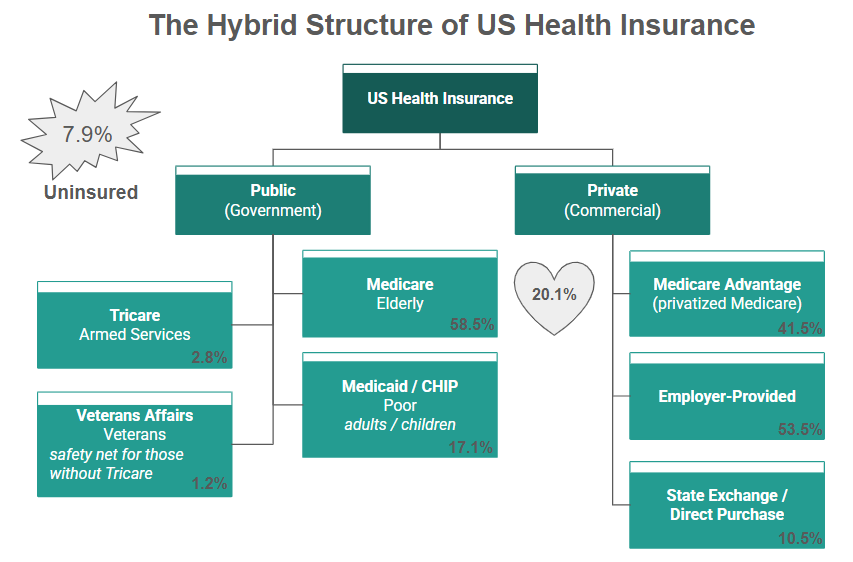
This is how the US Health Insurance system is structured and who it serves. The percentage of the population covered by that insurance is reflected in each box. (Source: 2025 Census) Note the heart represents all those covered by a Medicare plan within the population on the whole, and the box percentages are the subsets of those on Medicare public vs. private plans.
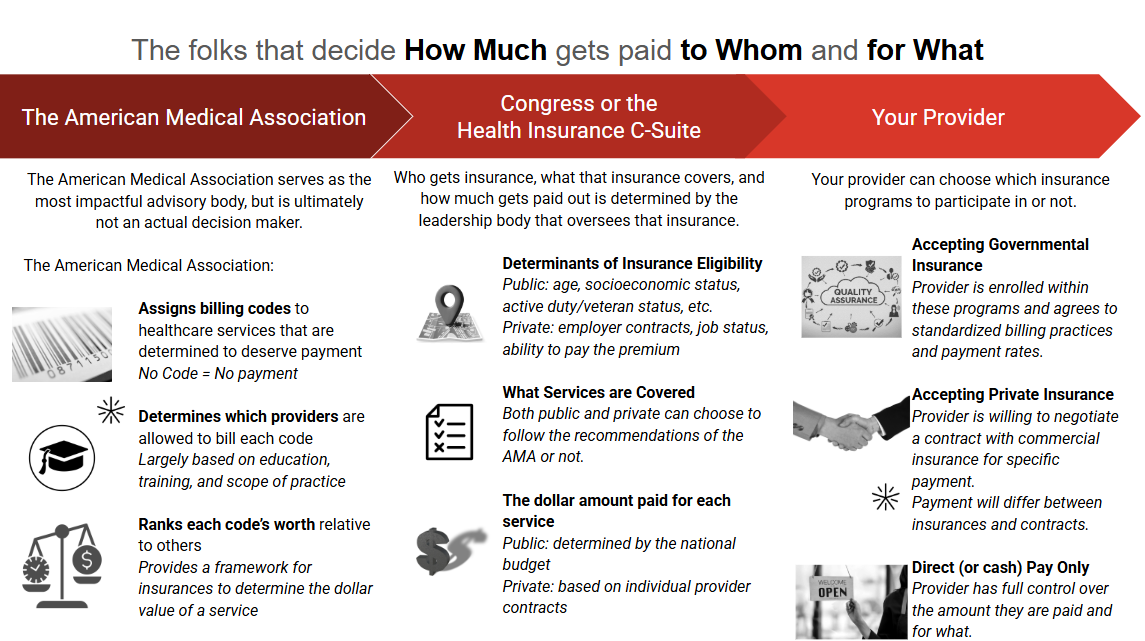
This chart essentially shows who influences healthcare payment from start to finish. Reading through, you may notice the process itself is not that complicated. What adds complexity is how many folks are involved. With a lot of “cooks in the kitchen”, per se, it can be difficult to tell what’s being served, by whom, and how much your bill will be at the end of the night.
Part 2: How YOU - the everyday citizen in need of healthcare - can Reclaim your Power
You may have noticed on the second infographic above, there were a couple asterisks. I put those in just for you, as they indicate where you can influence healthcare payment. While there are other things you can do to impact this process, I’m opting to focus on these two as they are the most tangible and actionable right now, and while you may note that they are positioned at the beginning and end of the process, they both have the potential to impact the middle as well.
OPTION 1: Help solve the problem of No Code, No Payment.
Is there something your provider does for you that’s not billable, or not covered by insurance? Consider asking them if it’s because they can’t bill for it, or if because your insurance plan doesn’t cover it. And if that’s the case, there is a way you can help. Anyone, and I mean anyone can submit a CPT Code Change Application to the American Medical Association. See the process here. Obviously, though, strength lies in numbers. If you are considering participating in or advocating for a code change application, reach out to groups of professionals - professional associations, interdisciplinary groups, etc. Forming a collective effort will strengthen the application and have greater impact. Physical Therapist’s professional association and primary advocacy group is the American Physical Therapy Association.
OPTION 2: Take action to give your provider more contract negotiating power.
In 2026, the Colorado House passed HB26-1002 which required private insurance companies to clean up their “ghost networks” for mental health providers. What is a ghost network? It’s the industry term for when you get new insurance and go to the in-network provider list, only to call those providers and discover they no longer accept your insurance. Functionally, this list is no longer an “in-network” list, it’s a “ghost” list - a list of folks that were, but are no longer.
As you can imagine, the accuracy of these lists is pretty critical. Legally, insurance companies are required to demonstrate “network adequacy” (read: enough contracted providers to actually meet the need) in order to continue to provide insurance in your area. But when insurances submit these ghost lists as “proof” of network adequacy, they don’t actually have enough providers to meet your needs and the providers they do have are getting paid less and are inundated with clients as the only folks in-network.
Cleaning up these ghost networks - ensuring the lists are accurate and reviewed regularly - is a win-win for you and your provider. A clean network list ensures true network adequacy for you, meaning more provider choice and no more pointless calls, and it gives your provider more negotiating power as the insurance companies are under pressure to meet network adequacy, which then results in a higher paying contract.
In 2027, physical therapists in Colorado will be a part of an interdisciplinary group proposing an expansion on HB26-1002 that will require insurances to clean up their ghost networks across the span of healthcare providers, and we’ll need your help by contacting your legislator to state your support and get that bill passed. Stay tuned.
In Summary, “Healthcare is not personal - it’s political.”
Don’t like how it’s going? Take action.
But not right now. We just got through an election. Take a well-deserved break. We’ll revisit this in 2027.